


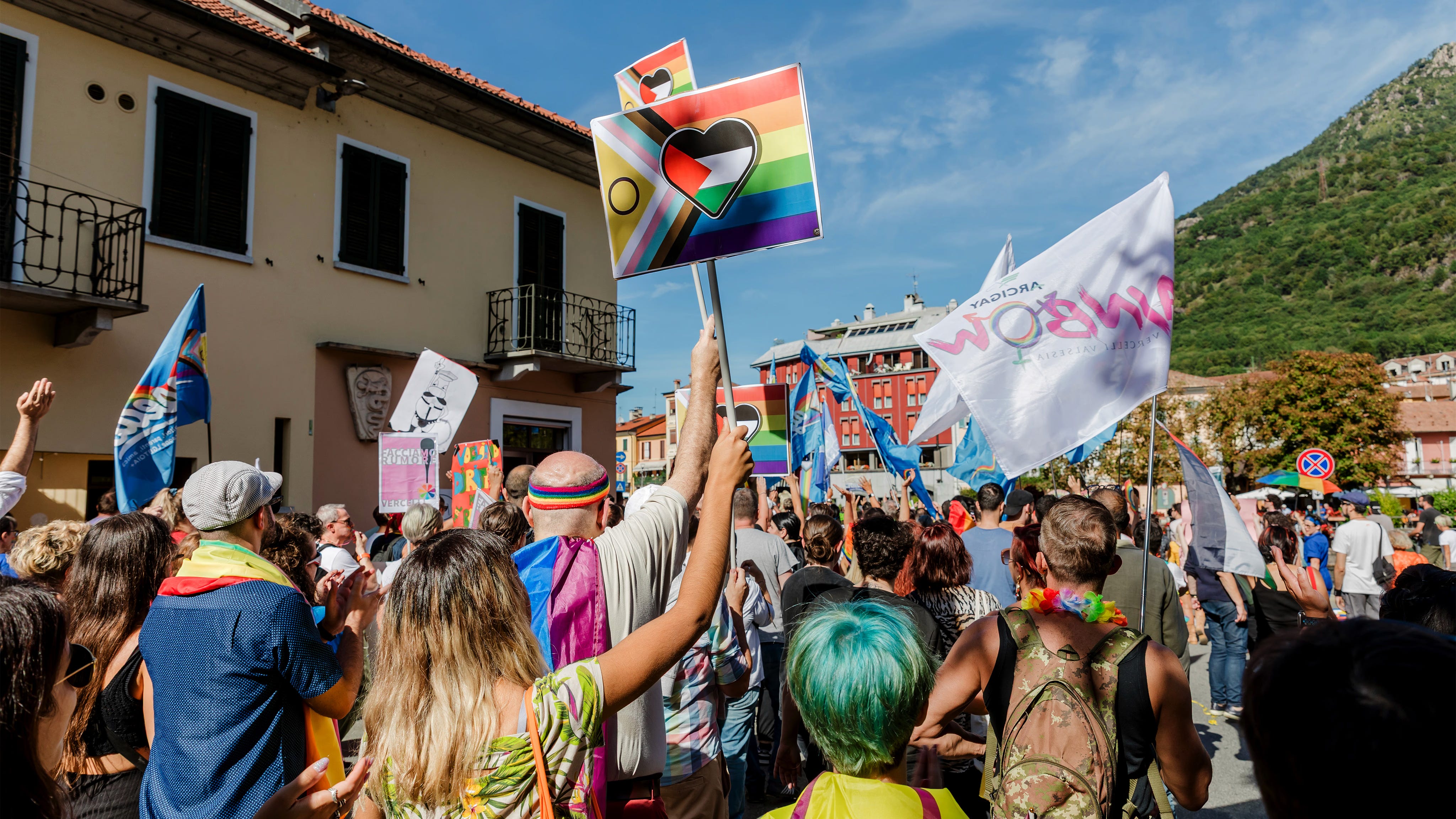
On October 4, the province where we grew up (the Verbano-Cusio-Ossola, tucked between the lakes and the Alps of Piedmont) holds its Pride. That gave us a reason to return to the idea at its core: intersectionality.
The Wheel of Privilege and Power visually represents how intersectionality works, made of concentric rings sliced into categories (gender, sexuality, skin color, ability, wealth, language). The closer you sit to the center, the more structural power one holds. Popularized by educator Sylvia Duckworth and grounded in Kimberlé Crenshaw’s work on intersectionality, it’s a genuinely useful visual tool. One picture, and the abstract idea that privilege is layered and cumulative suddenly clicks.
We want to use the wheel here in Italy too, so we’re working on localizing it to the Italian context.
Among the many versions out there, the one we found most ready-to-use was Rachel Cottam’s, an expert in workplace equality, so we started with her version, which you can see here: https://rachelcottam.com/2024/06/27/what-is-the-wheel-of-privilege-and-power/
We had to make some changes to make it work in Italy. For instance, both Rachel Cottam’s wheel and CCR’s one are built for contexts like Canada and the USA, where citizenship is based on ius soli; the language ring rewards bilingualism; and they include categories for settlers and Indigenous peoples. None of these axes work well in Italy.
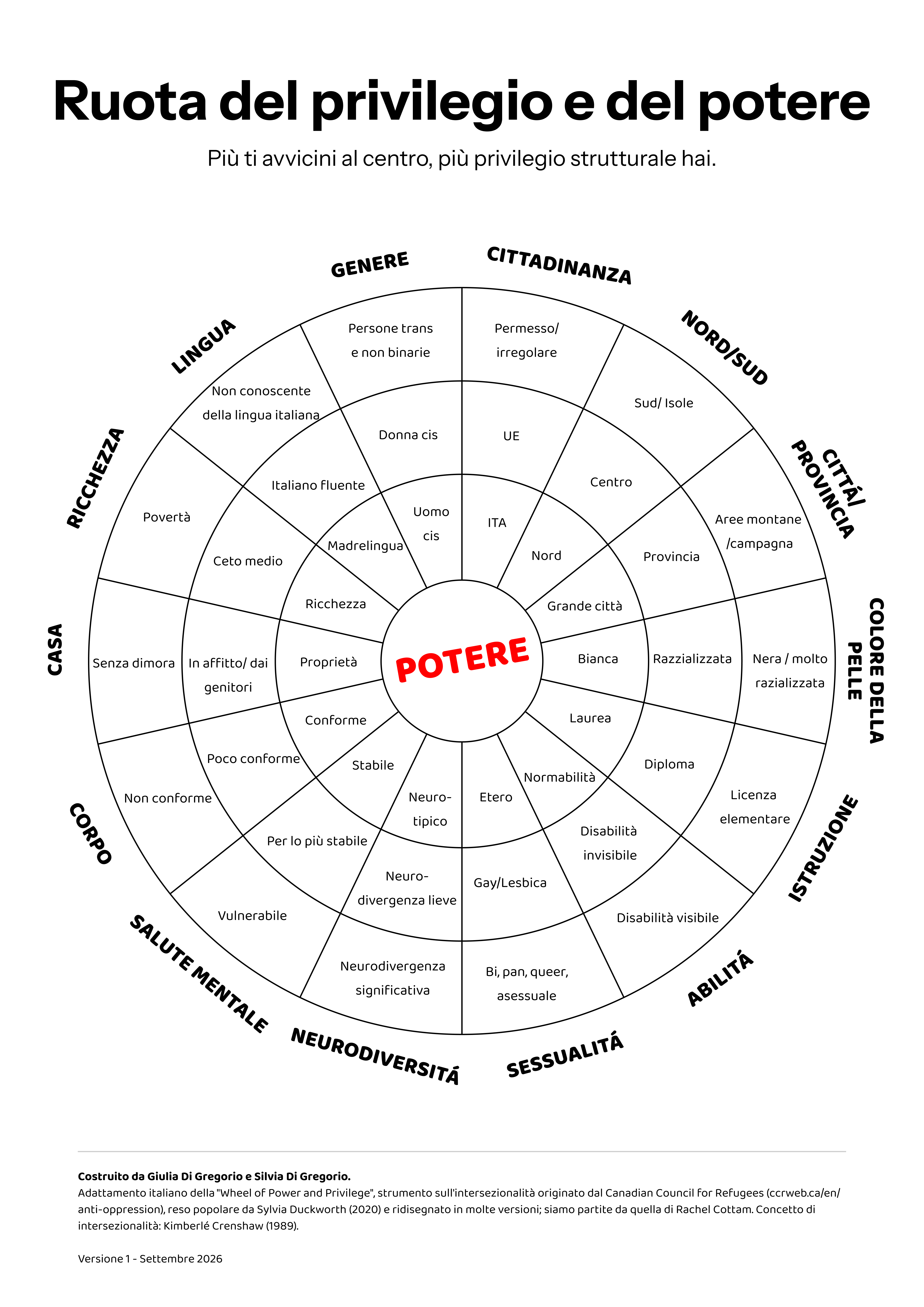
Cultural hegemony, drawn as a wheel
What does privilege actually look like in Italy? We reached for someone who understood power in Italy better than almost anyone: Antonio Gramsci.
Gramsci coined the concept of cultural hegemony: a dominant group makes its own language, customs, and origins feel natural and universal, symbolically, for everyone. In cultural hegemony, the power relations underneath become invisible, and privilege is partly the comfort of never having to notice you have it.
Once you hold the wheel up to that idea, several rings have to change:
Language. In Italy, the privilege isn’t being bilingual; it’s being a native Italian speaker. Speaking the standard language without an accent, without effort, without translation, is an invisible advantage most native speakers never register.
Citizenship. In Italy, citizenship is inherited by blood (ius sanguinis). A child born and raised here to non-citizen parents can spend two decades waiting for what others receive at birth.
North and South. This is Gramsci’s most direct contribution with “Southern Question” that framed the North–South divide not as a natural difference in temperament or productivity, but as a historical product of power, the industrial North structured around the subordination of the agrarian South.
City and province. Still framed by Gramsci, it’s the everyday advantage of growing up in an urban center versus inland areas, small towns, and the countryside.
The body and identity
Gramsci reshaped the material and geographic axes. But privilege in Italy also runs through the body and identity. Starting from the Canadian Wheel, we leaned on contemporary Italian voices to draw these dimensions related to body and identity:
Sexuality. We changed this axis a little bit to emphasize the invisibility of bisexuality, pansexuality, and asexuality from Heterosexual > Gay Man > Lesbian, Bi, etc. to Heterosexual > Gay, Lesbian > Bi, pan, etc.
Ability. Drawing on Marina Cuollo’s work on ableism, we replaced the medical language of “mild” and “severe” disability with the norm itself. At the center sits “Normabilità”, the unspoken standard of the “normal” body around which society designs its spaces, language, and expectations. Ableism isn’t about individual bodies; it’s about a world built for only some of them.
The body. Rachel Cottam’s wheel measured “body size” on a straight line: slim at the center, large at the edge. But size isn’t really a line. Fatphobia is a structural penalty (denied medical care, lower wages, a world of spaces built for smaller bodies). In contrast, a body of unusual height or proportion doesn’t fit the scale at all. Even very thin bodies draw comment and get read as sick, though the stigma there is real without being structural in the same way. So we stepped back from size and applied a lens of conformity to a bodily norm. The privilege is the narrow band of the “right” body (the one that draws no comment), and you can fall outside it in more than one direction. (Italian research on body-shaming has had to name skinny-shaming alongside fatphobia, too.)
Skin color. Italians are chromatically varied, often olive-skinned, so the Canadian wheel’s “white, different shades, dark” scale doesn’t work here. In Italy, the racialized person isn’t “the one with darker skin”, but the one society marks as “not really Italian” and treats accordingly. The labels (white / non-racialized, racialized, Black / heavily racialized) still borrow the vocabulary of color for brevity, but the criterion is the degree of racialization, not skin tone.
An experiment
We’re calling it an experiment because that’s what it is: a first draft, built by two sisters who got interested in the diagram and decided to redraw it to localize it in our country of origin. We want people to use it, question it, and improve it.
We’re hoping it gets picked up (in Italian schools, teams, and communities) as a starting point for harder, more honest conversations about who gets to stand near the center, and who doesn’t.
That felt like the right thing to explore 🏳️🌈
Resources
The original wheels
Canadian Council for Refugees (CCR): https://ccrweb.ca/en/anti-oppression
Rachel Cottam, “What is the wheel of privilege?”: https://rachelcottam.com/2024/06/27/what-is-the-wheel-of-privilege-and-power/
Italian adaptation
Antonio Gramsci - cultural hegemony and the “Southern Question” (the North–South divide as a historical product of power). Prison Notebooks.
Roberta Parigiani (Movimento Identità Trans) - gender affirmation and self-determination for trans and non-binary people. https://www.mit-italia.it
Marina Cuollo - ableism as a cultural structure; the “normative” body as an implicit standard. https://www.marinacuollo.com/